
Sex Offender Checks in Meriwether County
The Georgia Sex Offender Registry search is the main public channel for a Meriwether County sex offender search. The Georgia Bureau of Investigation manages the central system, and county sheriffs supply and maintain registration data under O.C.G.A. § 42-1-12. Choose Meriwether in the county field when the person's registered county is known. Name, city, ZIP, address, and radius tools help when only part of the location is known. Spelling and aliases matter, so a narrow name query should not be the last check.
Meriwether County Sheriff staff perform the local registration and verification work. Call the Sheriff's Office at 706-672-4489 to report suspected noncompliance or an address that appears wrong. The reviewed county site did not publish a separate local registry map, direct registration-unit address, or counter schedule. The official state search and a direct sheriff call are therefore the supported county channels. Registry information changes as sheriffs submit updates, and the GBI does not promise that the database is complete.
Meriwether Registry Verification
The sheriff's role is more than accepting a form. Georgia places local registration and verification duties with each county sheriff. An ordinary registrant generally appears in person once each year during the 72 hours before the person's birthday. A person classified as a sexually dangerous predator also reports six months after the birth month and is subject to enhanced monitoring. These schedules describe state practice, but readers should confirm a specific compliance question with Meriwether County Sheriff rather than infer it from an old profile date.
The GBI registry page presents the state program that supports local verification.
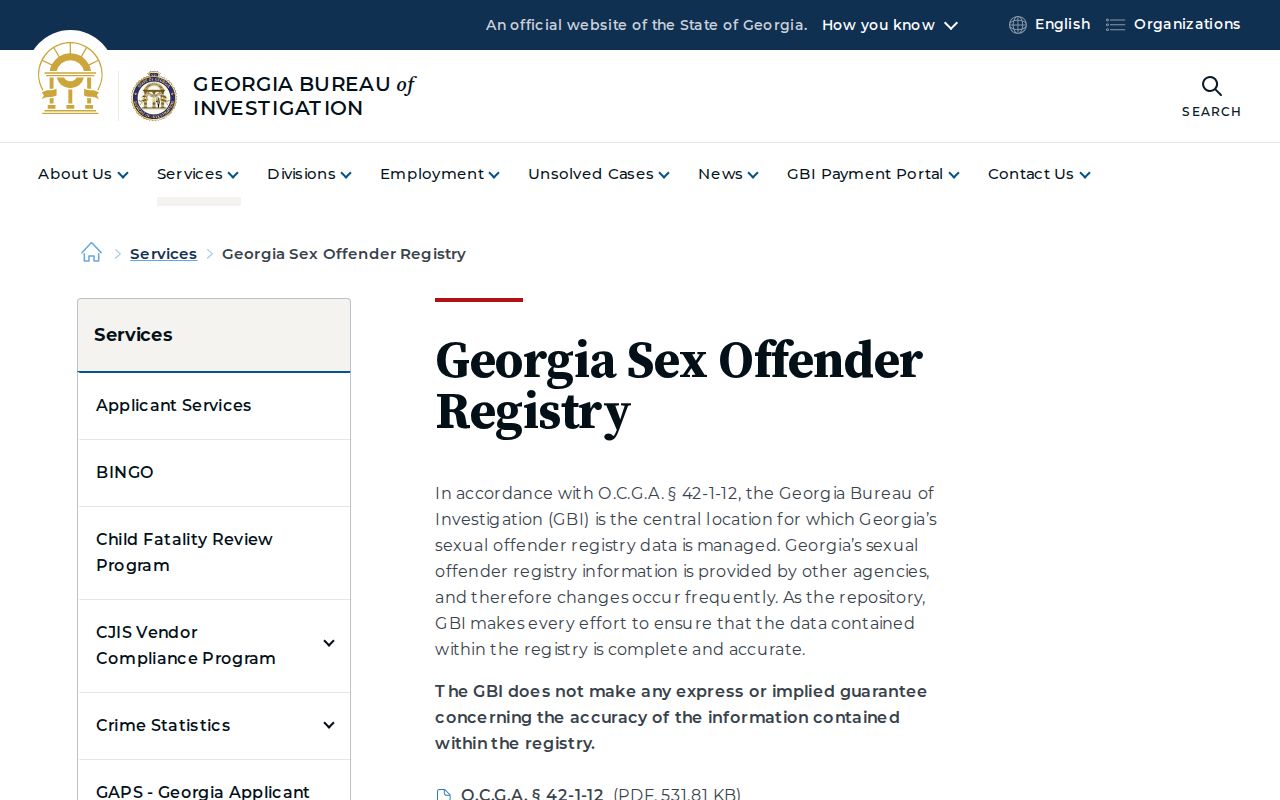
Local address concerns still belong with the Meriwether County Sheriff.
Meriwether County Sheriff
Registration and compliance reporting
706-672-4489
Greenville, Georgia
Incorrect information should go to the responsible office. The sheriff can investigate a local address or compliance concern. GBI manages the statewide platform and can address system questions at 404-270-8399. Do not post a suspected error on social media or confront the person listed.
How to Search the Georgia Sex Offender Registry
The GBI registry landing page leads to a Conditions of Use screen. Accepting those terms opens the public search. The safest method begins with the facts already known, then broadens the query. A county filter can find Meriwether County registrations without requiring an exact name. An address and radius search may be more useful for neighborhood awareness. Search results should be checked against the full profile before drawing a conclusion.
- Open the official GBI search and read the Conditions of Use. Select “I agree” to enter the search.
- Enter a name or choose Meriwether County. Add city, ZIP, address, or radius details only when they help.
- Review possible results for aliases and physical details. Do not rely on a name alone.
- Open the profile and read offense, address, classification, verification, and status fields together.
| Field Label | Type | Required | Notes |
|---|---|---|---|
| First / Last Name | Text | No | Spelling and known aliases can change results |
| County | Dropdown | No | Select Meriwether for county results |
| City / ZIP | Text | No | Narrows a geographic search |
| Address | Text | No | Supports proximity searching where enabled |
| Radius | Dropdown | Conditional | Live map options may change |
| Type / Status | Selection | No | Available options can change |
Meriwether and National Searches
A Georgia search is the best first step for a known Meriwether County connection. The National Sex Offender Public Website, operated by the U.S. Department of Justice, adds participating state, territorial, and tribal registries. It can help when a person recently moved, uses an address near a state line, or has an unclear registration state. NSOPW does not replace the underlying Georgia profile. Open the source registry entry for the most direct state data and warnings.
The official NSOPW interface supplies that cross-state search layer.
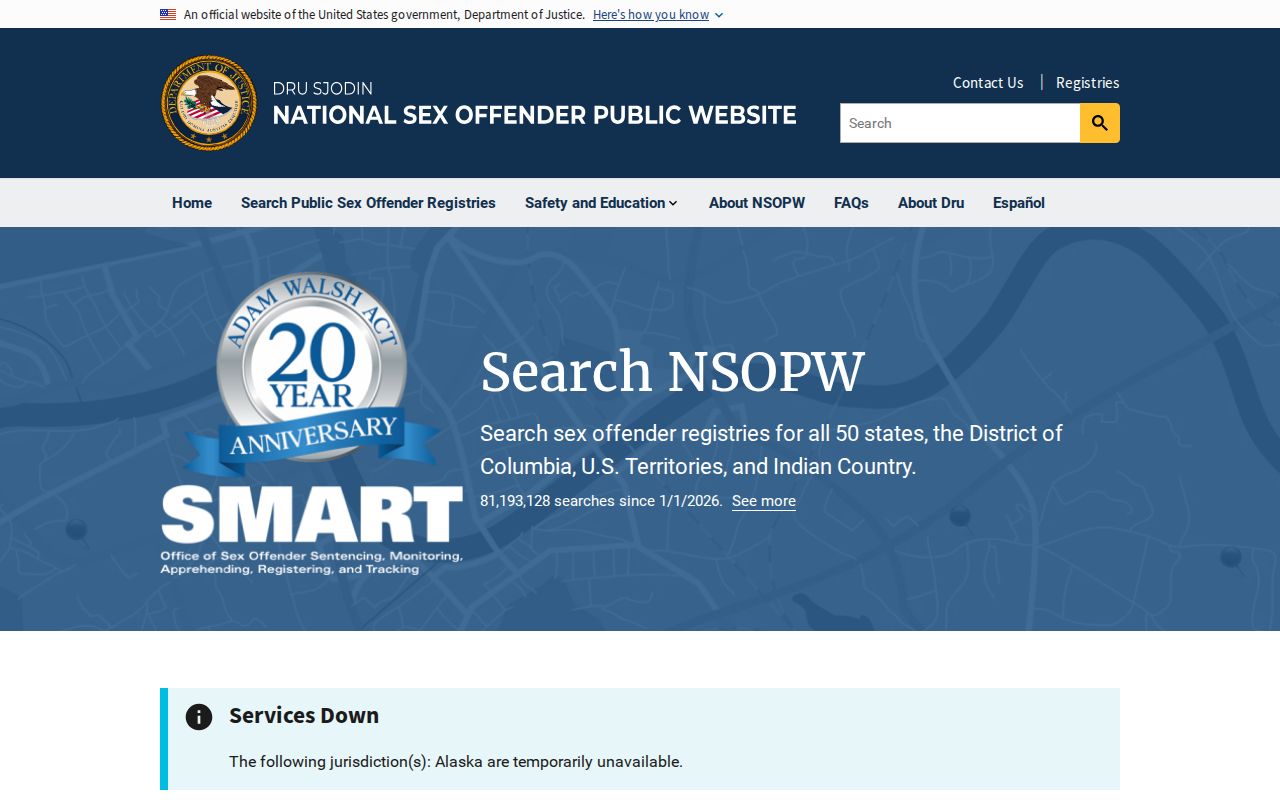
Return to the Georgia source profile to confirm state details.
The two systems can show different timing because each source supplies its own information. Georgia reports that registry updates occur daily and that sheriffs must update submitted changes within two business days. A missing result is not proof that no duty exists. A nonqualifying offense, delayed submission, different spelling, removal, death, or a completed First Offender matter identified by GBI may explain an absence.
The GBI registry FAQ explains eligibility and removal questions. It also reinforces why a public search should be read as a statutory registry check, not a broad test of someone's character or full case history.
Inside a Registry Profile
A Meriwether County registry profile combines identity, location, offense, and compliance fields. Read all of them. A photo or shared name alone is not enough to match a person. The offense and conviction jurisdiction describe why registration was required, while classification reflects a statutory risk assessment. Neither field states that a new crime occurred. Dates also matter because an address or verification entry can change after the page was last viewed.
The Georgia registry portal displays the public search and profile framework.
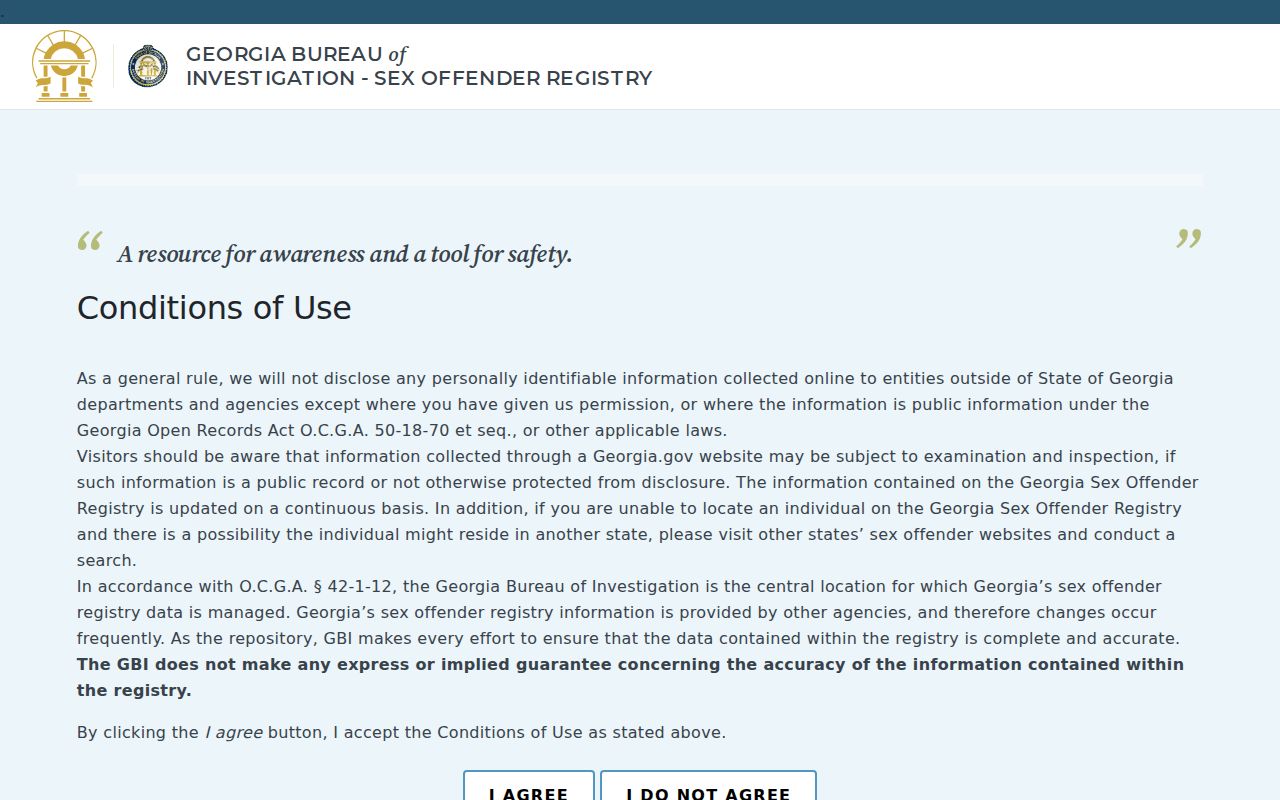
Match several fields before deciding a result identifies the intended person.
| Name & Aliases | Legal name and alternate names used to identify a possible match |
|---|---|
| Photo & Description | Photo, sex, race, age, height, weight, hair, eyes, scars, marks, and tattoos when displayed |
| Registered Address | Residence and registration county, plus school or work data when the law permits display |
| Offense & Statute | Qualifying offense, statute, conviction date, and jurisdiction |
| Classification | Level I, Level II, sexually dangerous predator, or other shown status |
| Compliance Details | Last verification and compliance information supplied to the registry |
Read Meriwether Profiles Carefully
Classification and registration are legal categories. They are not a forecast. Level I means SORRB assessed a low risk of reoffense; Level II means moderate risk; sexually dangerous predator is a separate statutory status with added monitoring. Georgia does not use the public federal Tier I, Tier II, and Tier III model as a simple duration chart. Treating its labels that way can create a false result.
Address data also needs care. A listed address may have been updated after a move, submitted for review, or entered incorrectly. If the location affects a safety plan, check the verification date and ask Meriwether County Sheriff to confirm what it can lawfully disclose. Registry information should be one part of practical awareness, not a reason for confrontation.
Note: A profile records statutory facts and reported status; it does not establish present conduct or predict what a listed person will do.
Georgia Registration Levels and Requirements
Georgia generally requires lifetime registration, excluding time spent incarcerated, unless a court grants lawful relief. Risk level and registration duration are separate questions. SORRB assigns the risk classification, while O.C.G.A. § 42-1-12 sets registration duties. O.C.G.A. § 42-1-19 provides routes for some eligible people to petition a court for release. A chart that assigns a short term to Level I and a longer term to Level II would be wrong for Georgia.
| Classification | General Duration | Verification |
|---|---|---|
| Level I | Generally lifetime unless court relief applies | Usually annual birthday-window reporting |
| Level II | Generally lifetime unless court relief applies | Usually annual birthday-window reporting |
| Sexually Dangerous Predator | Generally lifetime unless lawful relief applies | Annual reporting plus a six-month report and enhanced monitoring |
Meriwether Registry Release Petitions
Removal is not automatic when time passes. Under O.C.G.A. § 42-1-19, some people may ask a court for release after completing incarceration, parole, supervision, and probation and meeting the statute's other conditions. One route involves ten years having elapsed; another can involve Level I classification. The exact route depends on the record and legal criteria, not just a profile label.
A denied petition generally cannot be renewed for two years. Court orders, the registry, and the underlying criminal case serve different purposes, so anyone reviewing their own status should use the actual docket and obtain legal advice where needed. The Meriwether County Criminal Court Cases page explains how to reach the clerk for filed orders and certified dispositions.
The GBI registry FAQ is the official starting point for release questions.
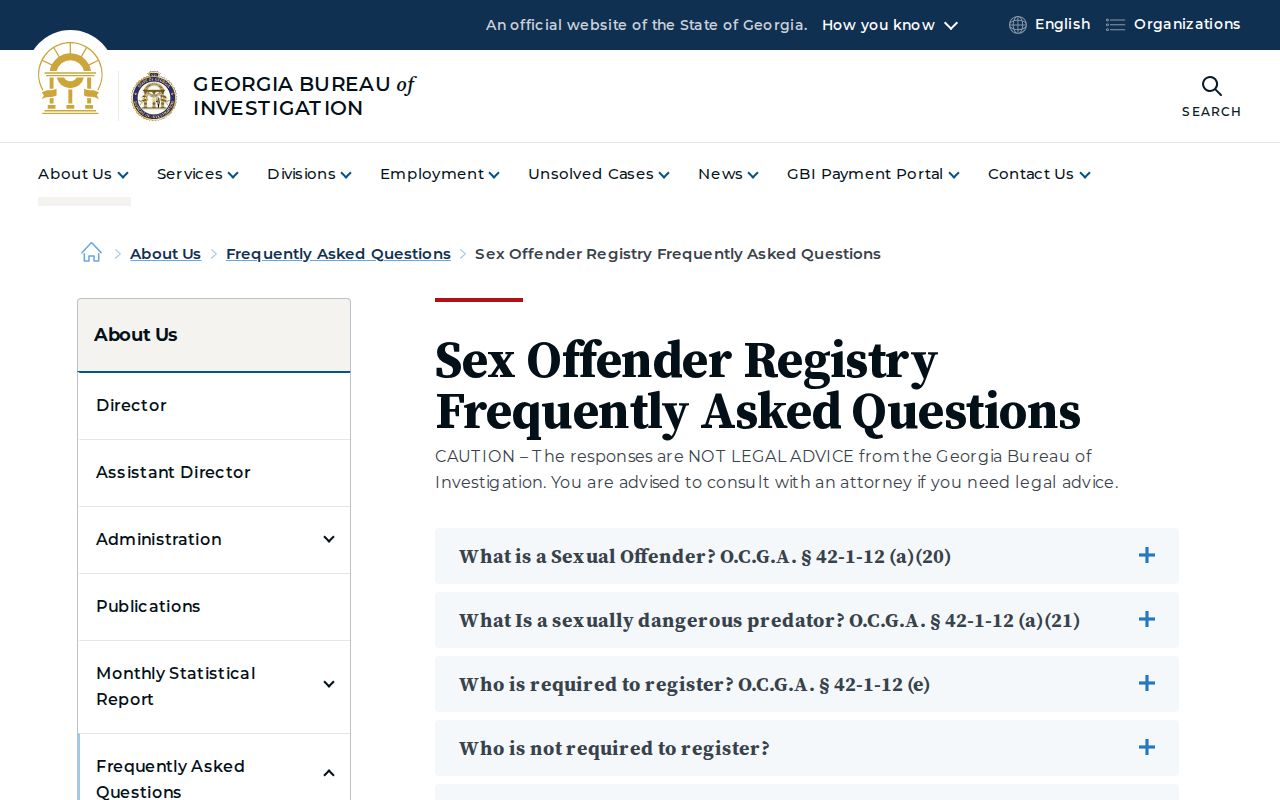
A court order, not time alone, controls lawful release.
Meriwether Address Rules
Georgia residency and employment restrictions appear in O.C.G.A. §§ 42-1-15 and 42-1-16. They include distance rules tied to specified locations, but effective dates, status, property history, and statutory exceptions can change how a rule applies. A simple statement that every registrant must always remain a fixed distance from every school, park, or child-care site would omit those important limits.
Interstate moves have a clearer reporting point. Section 42-1-12 requires an out-of-state mover to report the new address to the former county sheriff and register in the new state within 72 hours. For a Meriwether County move, confirm the steps with the Sheriff's Office before the deadline rather than relying on an online profile to update first.
Community Notification and Lawful Use
The Georgia registry and NSOPW support personal, family, and neighborhood safety planning. Results may guide a resident to review a route, talk with family about boundaries, or report a suspected address error. They do not authorize surveillance, threats, public shaming, or private enforcement. Suspected violations belong with Meriwether County Sheriff or GBI. An emergency belongs with 911.
Use registry data lawfully: The registry's Conditions of Use prohibit harassment, threats, intimidation, and criminal misuse. Such conduct can bring civil or criminal consequences under Georgia law. Report a concern to law enforcement instead of confronting anyone.
Failure to register, giving false information, or missing the birthday reporting window can be prosecuted as a felony under O.C.G.A. § 42-1-12(n). The statute sets serious penalties, but a public user should not decide from an old address alone that a violation occurred. Send the factual concern and profile details to the sheriff for review.